Realistic Tech Budgeting for Business Leaders
Why most tech estimates are way off and how to plan better

Edie Woelfle
February 17, 2026
Why most tech estimates are way off and how to plan better

If you’re new to software engineering, $30,000 sounds like a lot of money.
In software? That’s barely a month’s spend.
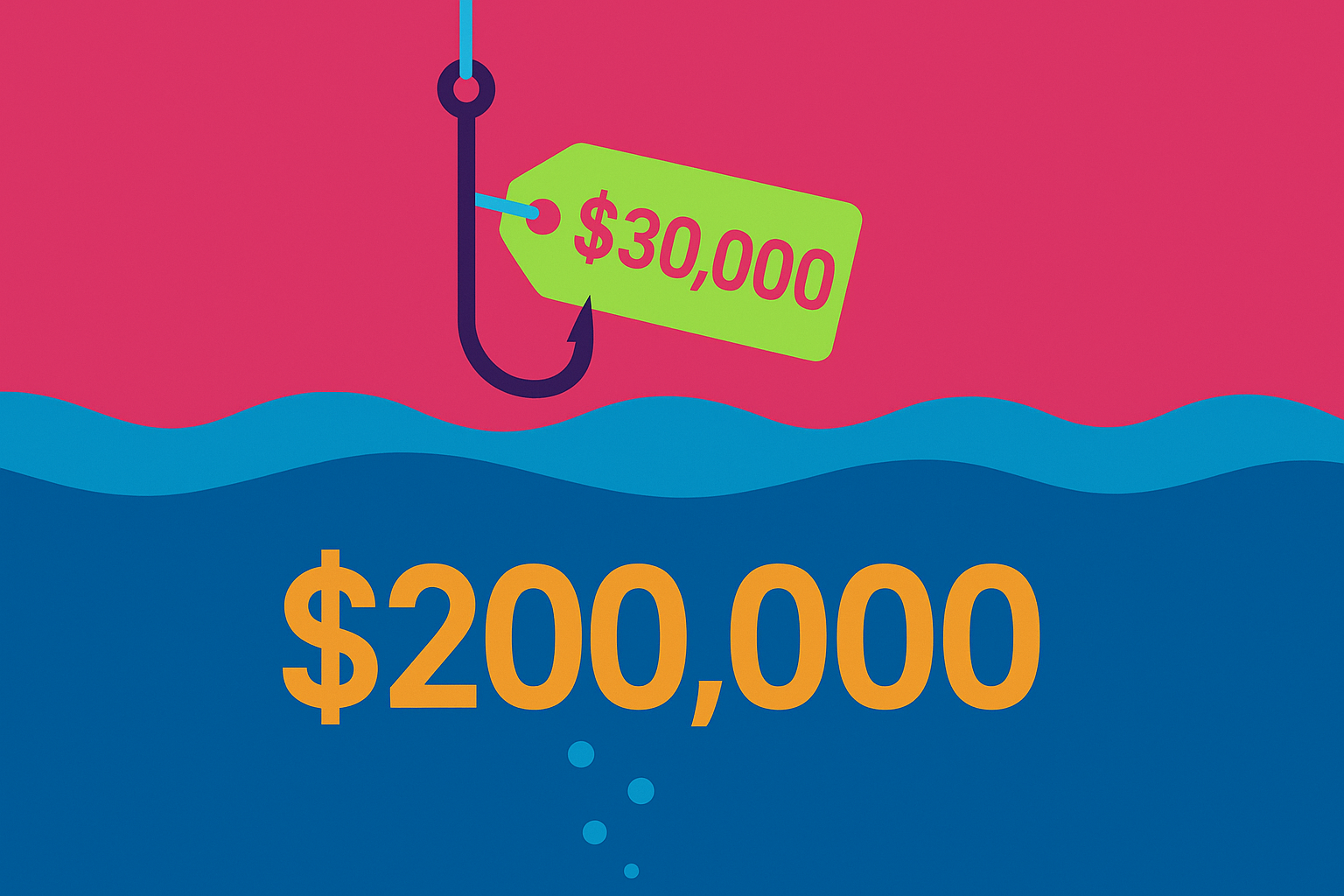
Here’s the dirty little secret of the tech industry: offshore teams love throwing out numbers like $30,000 or $60,000 for your MVP. Believe me, I’ve seen it happen over and over. That number is carefully chosen - it’s big enough to sound reasonable to a non-tech founder, but small enough to seem achievable.
It’s bait. And once you’re hooked, the real costs start piling up.
Let’s talk real numbers for a second.
According to Netguru’s 2025 industry research, businesses are now paying an average of $171,450 for custom mobile applications. For web applications, Appinventiv’s 2025 data shows costs ranging from $40,000 for simple apps to over $400,000 for enterprise-grade solutions.
Simple applications with basic functionality typically cost between $5,000 and $50,000. Medium-complexity apps with more robust features require investments ranging from $50,000 to $120,000. Complex applications incorporating advanced technologies demand substantial budgets between $100,000 and $300,000.
But here’s the kicker - those numbers are actually inflated because most teams are doing it wrong.
They skip requirements gathering. They jump straight into coding without prototypes. They treat QA like it’s a luxury instead of a necessity.
Then they wonder why everything takes three times longer and costs twice as much as they budgeted.
Want to know what actually blows up tech budgets? It’s not the engineering - it’s all the stuff people skip because they think it’s “extra.”
No requirements = building the wrong thing. You spend $50,000 building features nobody asked for because “a few conversations” aren’t enough to capture what you actually need. Writing proper requirements costs about $5,000-$10,000. Skipping it can waste $50,000+.
No prototyping = expensive experiments. A high-fidelity prototype costs about 20% of what building the actual product costs. That means you can test your idea with users, get feedback, and iterate for a fraction of the price. But most teams skip this and learn expensive lessons in production.
Treating QA as optional = paying for it later. Teams that skip proper QA spend 30-50% of their engineering time fixing bugs instead of building new features. Meanwhile, their users are frustrated and leaving.
Let’s talk about the elephant in the room: offshore development.
On paper, it looks amazing. According to DistantJob’s 2025 analysis, a senior developer in the US costs $100-$150 per hour. In Eastern Europe or South Asia? $27-$76 per hour. That’s potentially 70% savings!
But here’s what actually happens:
Onshore team: $150/hour × 500 hours = $75,000 for a feature. Timeline: 3 months. Quality: Gets it right the first time.
Offshore team: $50/hour × 800 hours = $40,000 for the same feature. Timeline: 6 months. Quality: Needs 2-3 rounds of fixes, bringing real cost to $60,000-$70,000 and timeline to 9 months.
See the problem? Research from Baytech Consulting shows that offshore projects often experience a 20% delivery delay due to time zone differences and communication barriers. When you add in the cost of rework, the supposed 40-70% cost savings often evaporate entirely.
The offshore team ends up costing nearly the same - they just take way longer because the quality isn’t there the first time around.
Communication gaps. Time zone differences. Different interpretations of requirements. All of this adds up to more revisions, more bugs, more delays.
If you don’t have the luxury of time (and most startups don’t), why bother with offshore?
I’ve seen startups blow 7 months with an offshore team only to realize they needed to start over with a local team. That’s 7 months of missed market opportunity, frustrated investors, and burned capital.
But wait, you might say, what about nearshore teams? They’re in better time zones, speak great English, and cost less than US teams. True! But you still need to do the basics - requirements, prototypes, proper QA. Geography doesn’t fix bad process.
And then there’s AI. Everyone’s talking about how AI is revolutionizing coding, right?
Tools like GitHub Copilot and ChatGPT can spit out code incredibly fast. We’re even seeing this thing called “vibe coding“ where developers quickly generate code focusing on speed and creativity.
Sounds amazing, right? Build faster, ship quicker, save money!
Here’s the reality: AI is great at spitting out SOMETHING fast. But it is never the right thing the first time.
A groundbreaking July 2025 study by METR found that experienced developers using AI tools like Cursor Pro with Claude 3.5 Sonnet were actually 19% slower than when coding without AI. Even more surprising? These developers thought they were 20% faster. The disconnect between perception and reality is massive.
Think about it - even Google and Microsoft, who literally created some of these AI coding tools, have strict limits on how their engineers use them. Google’s 2024 DORA report, based on responses from over 39,000 professionals, found that every 25% increase in AI adoption showed a 1.5% dip in delivery speed and a 7.2% drop in system stability. While 75% of developers felt more productive, the actual data told a different story.
Why? Because AI coding only creates real speed gains in certain specific areas, like writing unit tests or generating boilerplate code. GitClear’s 2024 research analyzing 211 million lines of code found that AI-assisted code had 4x more code cloning (copy/paste) and significantly less refactoring - indicators of lower long-term code quality.
For complex business logic? The stuff that makes your product actually work? AI often creates more problems than it solves. You end up spending just as much time reviewing and fixing AI-generated code as you would have spent writing it properly from scratch.
Look, I’m not a Debbie Downer on AI - I’m a realist breaking through the marketing hype to deliver the reality. I know where it’s at currently, and I know what needs to happen to make it viable long-term. AI tools absolutely have their place, especially for certain types of tasks. But right now? The marketing machine is warping people’s perception of how long building software actually takes.
A developer using AI can show you something working in a demo after a week. Cool! But that code is probably missing:
Proper error handling
Security considerations
Edge cases
Scalability
Turning that week-old demo into production-ready software? That’s when reality hits. What looked like a 1-week project is actually 8 weeks of proper development.
Here’s the breakdown nobody wants to show you, but you need to see:
Requirements & Planning: $5,000-$10,000
Design/UX: $5,000-$15,000
Prototype for testing: $3,000-$8,000
QA/Testing: $8,000-$16,000 (typically 20% of engineering)
Project Management: $6,000-$12,000
Buffer for surprises (20-30%): $13,000-$28,000
Total realistic budget: $80,000-$169,000
But remember what I said about teams doing it wrong? Most teams skip the first three items and wonder why they end up spending $200,000+ on endless revisions and rebuilds.
You’re looking at $150,000-$350,000 when done properly. Skip the basics? You’ll spend that plus another $100,000-$200,000 fixing everything.
Here’s your defense against bad estimates:
Ask for the breakdown. If someone quotes you $60,000, ask them to show you exactly what’s included. How many features? How many hours per feature? What support staff? If they can’t or won’t break it down, run.
Demand to see their process. Do they use Agile? Scrum? Do they have a Definition of Done? Can they show you their backlog? No process means no accountability.
Check their team composition. Are they just developers? Red flag. You need Product Owners, QA, and Project Management too.
Insist on prototyping first. Before anyone writes a single line of code, create a high-fidelity prototype and test it with real users. This costs 20% of the build but saves you from building the wrong thing.
Compare location vs. speed needs. If you need something fast and right, onshore is worth the premium. If you have time and patience for revisions, offshore can work - but know that “cheap” often ends up costing the same in the end.
That $30,000 estimate? It’s not a budget - it’s a trap. Real software development costs what it costs, and cutting corners just means you’ll pay more later.
The teams that succeed are the ones who:
Invest in proper planning upfront
Build the right support team around their engineers
Prototype before coding
Don’t skip QA
Understand that speed comes from doing it right, not from doing it cheap
Coming Next Week: The Hidden Cost of Technical Debt - How early shortcuts become expensive problems later.