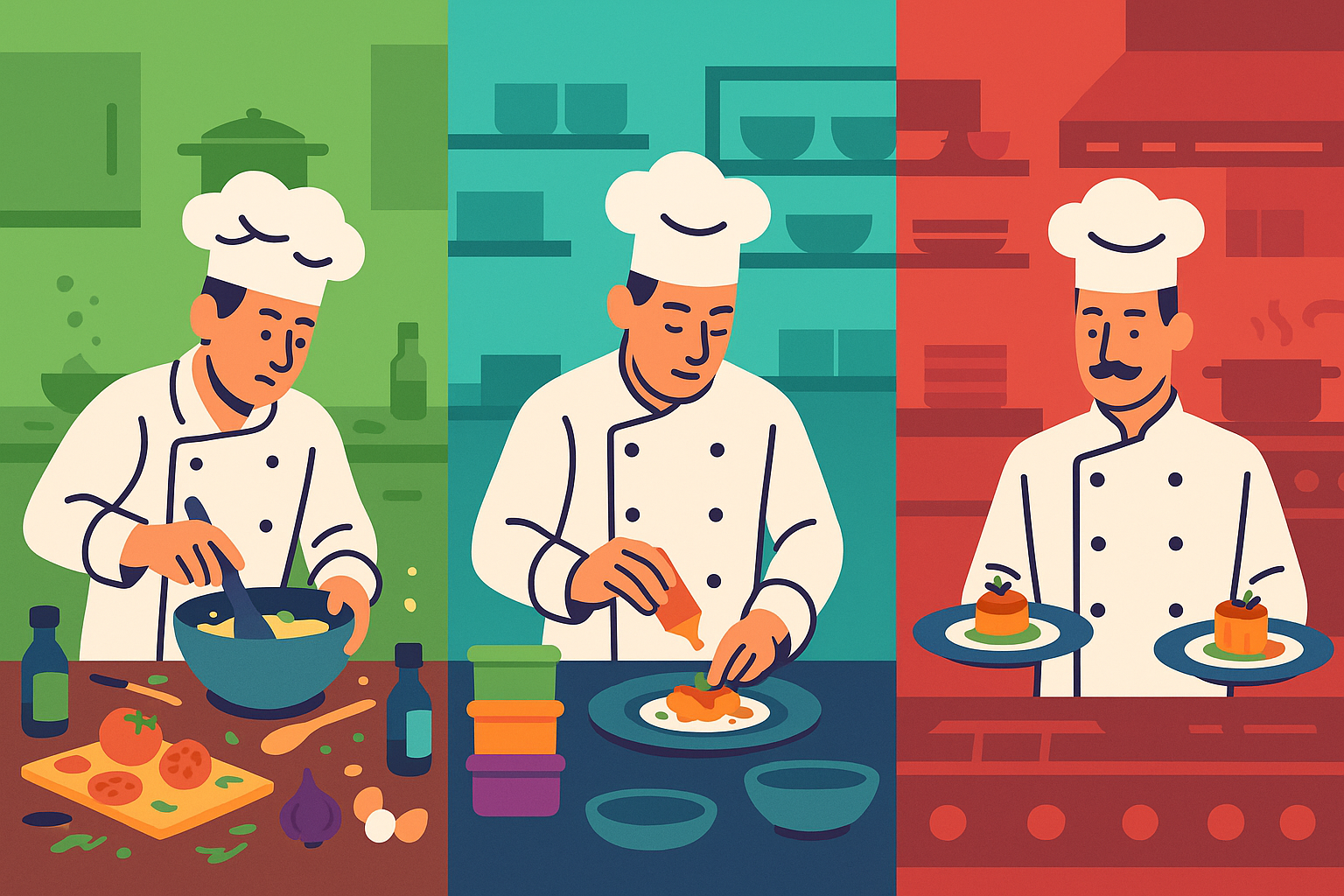
Imagine you're opening the hottest new restaurant in town. You've got big dreams, investors watching, and customers already making reservations. But here's the question: would you let your head chef experiment with brand new recipes directly in front of paying customers during dinner rush?
Of course not! That's a recipe for disaster (pun intended). Smart restaurateurs know you need different spaces for different stages of the cooking process. Your app works exactly the same way - and that's why you need three distinct "kitchens" for your software.
Kitchen #1: The Recipe Lab (Development Environment)
Every great dish starts in the recipe lab - a messy, experimental space where creativity runs wild. This is where your head chef (your developers) can:
- Try crazy ingredient combinations without judgment
- Burn things and start over without wasting expensive ingredients
- Test new cooking techniques dozens of times in one day
- Make a complete mess and nobody cares
In app terms: Your development environment is where developers write code for new features like user login systems, payment processing, or that cool dashboard you've been dreaming about. Code changes happen constantly - sometimes 50+ times per day - and crashes are just part of the creative process. Your developers might break the entire app while adding a simple button, and that's totally fine here.
Why you need it: Your developers need creative freedom to innovate. Nobody wants to accidentally crash your live app because they were testing whether that new "one-click checkout" feature actually works.
Kitchen #2: The Prep Kitchen (Staging Environment)
Once your chef perfects a recipe, it moves to the prep kitchen. This looks exactly like your main restaurant kitchen, uses the same equipment, but serves practice customers - think friends, family, and food critics doing advance tastings.
Here's what happens in prep:
- Recipes get tested under real restaurant conditions
- Your sous chefs (QA team) taste everything multiple times
- You discover that the new sauce is amazing but takes too long to prepare during rush hour
- Final quality checks before anything reaches paying customers
In app terms: Your staging environment is an exact copy of your live app, complete with fake customer data that looks real. This is where you test that new checkout flow with pretend credit cards, verify that email notifications actually send, and make sure your app works on both iPhones and Android devices. Your team might discover that the new feature works perfectly on laptops but crashes on mobile - exactly the kind of thing you want to catch before real customers see it.
Why you need it: This is your dress rehearsal. Better to discover your new user registration breaks on Safari browsers here than when potential customers are trying to sign up!
Kitchen #3: The Main Restaurant (Production Environment)
This is the real deal - where paying customers enjoy their meals, leave reviews, and hopefully become regulars. Everything here must be perfect because:
- Real money changes hands with every order
- One bad meal can ruin your reputation
- There's no room for "oops, let me remake that"
- Consistency is everything
In app terms: Your production environment is where real users create accounts, make actual purchases with real credit cards, and store their important data. This is your live app that appears in app stores, processes real payments through Stripe or PayPal, and sends actual email confirmations to customers. Every click, every form submission, every notification matters because this is your business in action.
Why you need it: This is your livelihood. One broken payment system here could mean lost sales, frustrated customers calling support, and potentially thousands of dollars in lost revenue.
The Kitchen Brigade: Your Movement Process
Just like restaurants have a strict process for moving dishes from prep to plate, your app needs a clear path:
- Create and perfect in the recipe lab (write code and test basic functionality)
- Test under real conditions in the prep kitchen (verify everything works like customers will use it)
- Serve to customers in the main restaurant (deploy to your live app)
The golden rule: Nothing goes to customers without passing through all three kitchens. No exceptions, even for "quick fixes."
Red Flag Alert: When Your Kitchen Staff Goes Rogue
Here's something that should make every restaurant owner nervous: what happens when your chef starts sneaking experimental dishes straight to paying customers, bypassing the prep kitchen entirely?
Imagine your head chef saying, "This tiny garnish change is so small, I'll just put it directly on tonight's special. What could go wrong?"
In restaurant terms: Your chef is essentially gambling with your reputation every time they skip the testing process.
In app terms: If your development team regularly feels like they can skip staging and push "small changes" directly to production, that's a massive red flag. We've seen developers say, "It's just a one-line code change" and then crash an entire production application during peak usage hours.
Why this is dangerous: Even the tiniest changes can have unexpected consequences. That "simple" text update might break the checkout flow. That "harmless" color change might make buttons invisible on certain devices.
What this tells you about your team: When developers regularly want to bypass your established process, it usually means one of three things:
- They don't understand the real risks involved
- They don't respect the system you've built
- Your process is too slow or cumbersome (which is fixable, but skipping it isn't the solution)
The professional response: Good developers respect kitchen boundaries. Great developers help you improve the process, not skip it entirely.
What Happens When Restaurants Cut Corners
We've seen too many startups try the "let's save money and skip the prep kitchen" approach. Here's what usually happens:
The Disaster Scenario: A restaurant decides to test new recipes directly on paying customers. Result? Food poisoning, terrible reviews, and an empty dining room.
The App Version: A startup pushes untested code changes straight to their live app. Result? The entire app crashes when users need it most, customer data gets corrupted, or the mobile app won't load for anyone with iOS updates. We've literally seen companies lose $50,000 in a single day because they skipped proper testing.
The cost difference? Testing a new feature in development costs maybe a few hours of developer time. Fixing a crashed live app while angry customers flood your support inbox? That's all hands on deck, potential refunds, and serious damage to your reputation.
Setting Up Your Three Kitchens: The Real Costs
Yes, running three environments costs more than one. But think about it:
- Recipe Lab (Development): Basic server setup, maybe $50-200/month - your cheapest environment since only developers use it
- Prep Kitchen (Staging): Professional setup with real integrations (test payment processors, email services), around $200-500/month
- Main Restaurant (Production): Full investment with capacity for all your users, SSL certificates, monitoring tools, backup systems - could be $500-5000/month depending on your user base
Smart scaling tip: Your staging environment needs the same features as production but doesn't need to handle 10,000 concurrent users. Scale the infrastructure, not the functionality.
Common Kitchen Mistakes We See
"We'll test with real customers": Never make your paying users your beta testers. They came to solve a problem, not to be part of your experiment.
"Our development environment is good enough for testing": Development environments are messy with fake data and don't reflect real user conditions. You need proper simulation with realistic data volumes and user behaviors.
"We'll copy our production environment exactly for staging": Your staging environment should have the same features but doesn't need identical server capacity. Smart founders scale appropriately to save costs.
"This change is too small to test": This is like saying a pinch of salt is too small to taste-test. Small changes can have big consequences, especially in complex systems.
Your Restaurant Success Plan
If you're just opening (pre-launch startup):
- Design all three environments from day one - set up development, staging, and production infrastructure before writing a single line of user-facing code
- Train your developers on the proper deployment workflow - code reviews, testing procedures, and launch protocols
- Never skip steps, no matter how rushed you feel - that "simple fix" could break everything
- Establish clear consequences for bypassing the process - your kitchen rules aren't suggestions
If you're already serving customers but only have production (common for early startups):
- Don't panic, but prioritize building your staging environment immediately - you're essentially flying without a safety net
- Start documenting your current codebase and create a proper repository structure
- Plan your environment expansion carefully - set up staging as an exact copy of production, then gradually move all future changes through the proper testing process
- Have a serious conversation with your team about why the process matters - and be prepared to find new team members if they can't respect it
Remember: every successful restaurant has multiple kitchens for good reason. Your app deserves the same thoughtful approach to ensure every customer gets a perfect experience, every time.
Ready to build your three kitchens the right way? Our team has helped countless tech founders create bulletproof development processes that ensure your customers always get five-star experiences. Reach out to us for all your software development and fractional CTO needs - we'll help you cook up success from day one.