When to Build vs. When to Buy: The Smart Decision Framework
Stop wasting money building things that already exist.

Edie Woelfle
March 17, 2026
Stop wasting money building things that already exist.

You’re building a product. Your engineer gets excited about creating a payment system from scratch. Or building custom authentication. Or designing a brand-new analytics dashboard.
Stop right there.
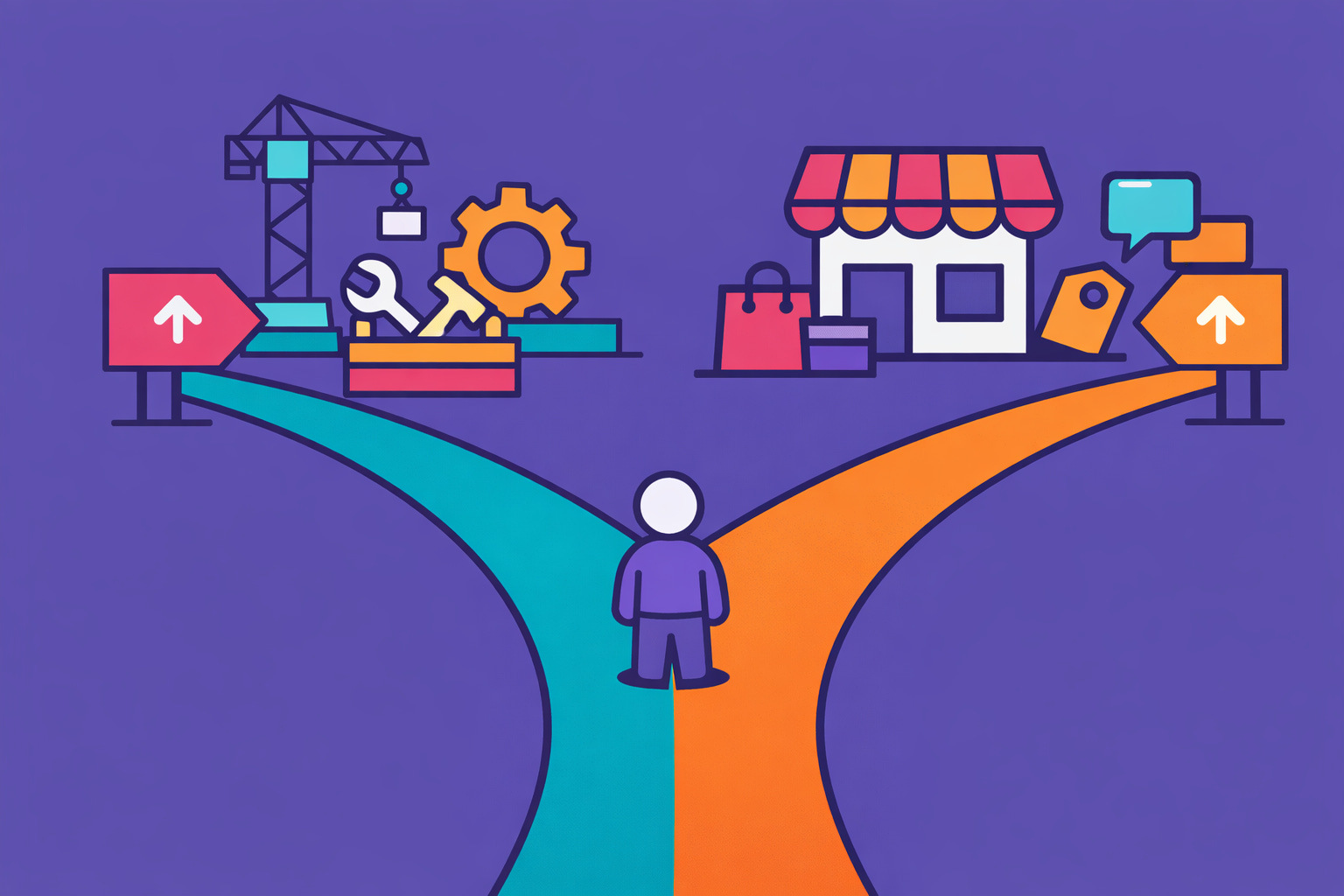
Here’s the question that will save you thousands of dollars and months of time: Is this a core function of what makes your product special?
If the answer is no, you probably shouldn’t build it.
Think of your product like a restaurant. You’re known for your secret sauce recipe. That’s what people come for. That’s what makes you different.
Do you also grow your own wheat to make the burger buns? Do you mine salt from the ocean? Do you build your own ovens?
Of course not. You buy those things so you can focus on perfecting your sauce.
Software works the same way. Some things deserve your time and money to build custom. Most things don’t.
Build custom when:
Buy (or use existing tools) when:
Let’s say you’re building a fitness app that uses AI to create personalized workout plans. The AI workout generator? That’s your secret sauce. Build that custom.
But here’s what you shouldn’t build:
Payment processing: Use Stripe. They’ve spent years making payments secure and compliant. You haven’t.
User login and passwords: Use an authentication service like Auth0 or Firebase. Password security is complicated and one mistake could expose all your users’ data.
Analytics: Use Mixpanel or similar tools. They already track user behavior really well.
Email sending: Use SendGrid or Mailgun. Keeping emails out of spam folders is an entire job by itself.
None of these things make your fitness app better than competitors. Your AI workout plans do. So spend your money and time there.
When you build something from scratch that already exists, you’re not just paying for it once. You’re signing up to maintain it forever.
Every custom thing you build needs to be:
Multiply that by 10 custom systems and suddenly half your engineering time is spent maintaining old stuff instead of building new features.
This is called technical debt. It piles up fast when you build things you should have bought.
At Keiboarder, we don’t speak in buzzwords or theoretical best practices. We ask simple questions in plain English: What makes your product special? What’s just plumbing?
We’ve seen too many founders waste $50,000 building a custom authentication system when a $50/month service would work perfectly. We’ve watched teams spend six months on a payments flow when Stripe could handle it in a week.
Our approach is always: What actually works for your situation? Not what’s trendy. Not what sounds impressive. What gets your product to users fastest while keeping quality high.
We help you identify your core value—the thing only you can build—and then we help you find the best existing tools for everything else. This isn’t about cutting corners. It’s about being smart with limited time and money.
When we review your backlog, we flag anything that’s being built from scratch when a library or service already exists. We explain the tradeoffs clearly. And we help you decide based on your specific goals and budget.
Here’s a newer risk: AI coding tools can write code really fast. That sounds great until you realize it often builds everything from scratch.
Ask an AI to “build user authentication” and it might write 2,000 lines of custom code. A human engineer with experience knows to just install a proven authentication library in 10 minutes.
More custom code means more things that can break. More things to maintain. More complexity.
Without someone experienced supervising, AI tools will build custom solutions for problems that already have excellent off-the-shelf answers. You end up with way more code to manage than you need.
This doesn’t mean AI tools are bad. It means they need guidance from someone who knows when to say “use the existing library instead.”
Before your team builds anything custom, ask these three questions:
1. Does this differentiate us from competitors? If customers choose you specifically because of this feature, consider building it custom.
2. Does a good existing solution already exist? If yes, and it’s not your differentiator, use the existing solution.
3. Will we need to customize this heavily as we grow? If you’ll outgrow standard tools quickly, building custom might make sense. But be honest about timing—most companies can use standard tools much longer than they think.
Let’s say you have $100,000 to spend on building your product.
Option A: Build everything custom
Option B: Buy the commodity stuff
In Option B, you spent $95,000 making your product great at the thing that matters. In Option A, you spent $70,000 rebuilding wheels that already exist.
Which product do you think will be better?
Look at your current development plan. (If you don’t have one written down, that’s a different problem we can help with.)
Go through each feature and ask: Is this what makes us special, or is this basic infrastructure?
For the infrastructure items, search for existing tools that handle it. You’ll almost always find something good.
Make a rule for your team: Before building anything from scratch, spend 30 minutes researching if a tool or library already solves this well. If one exists and covers 80% of what you need, use it.
That simple habit will save you enormous amounts of money and time.
Deciding what to build and what to buy sounds simple, but it gets messy fast when you’re in the middle of it.
If you’re not sure whether you’re building the right things—or if you suspect your team is building custom solutions for problems that already have great tools—let’s talk.
We offer a one-hour strategy session where we’ll review your current plan, identify what should be built vs. bought, and give you a clear action plan. No jargon. No pressure. Just honest answers about what will work for your specific situation.
Coming Next Week: Money & Resources Recap