Your developer just pitched you an AI feature for your app. Or maybe you saw a competitor add AI and now you're wondering if you should too. Or perhaps you're looking at a proposal that includes "AI-powered" something-or-other and trying to figure out if it's worth the investment.
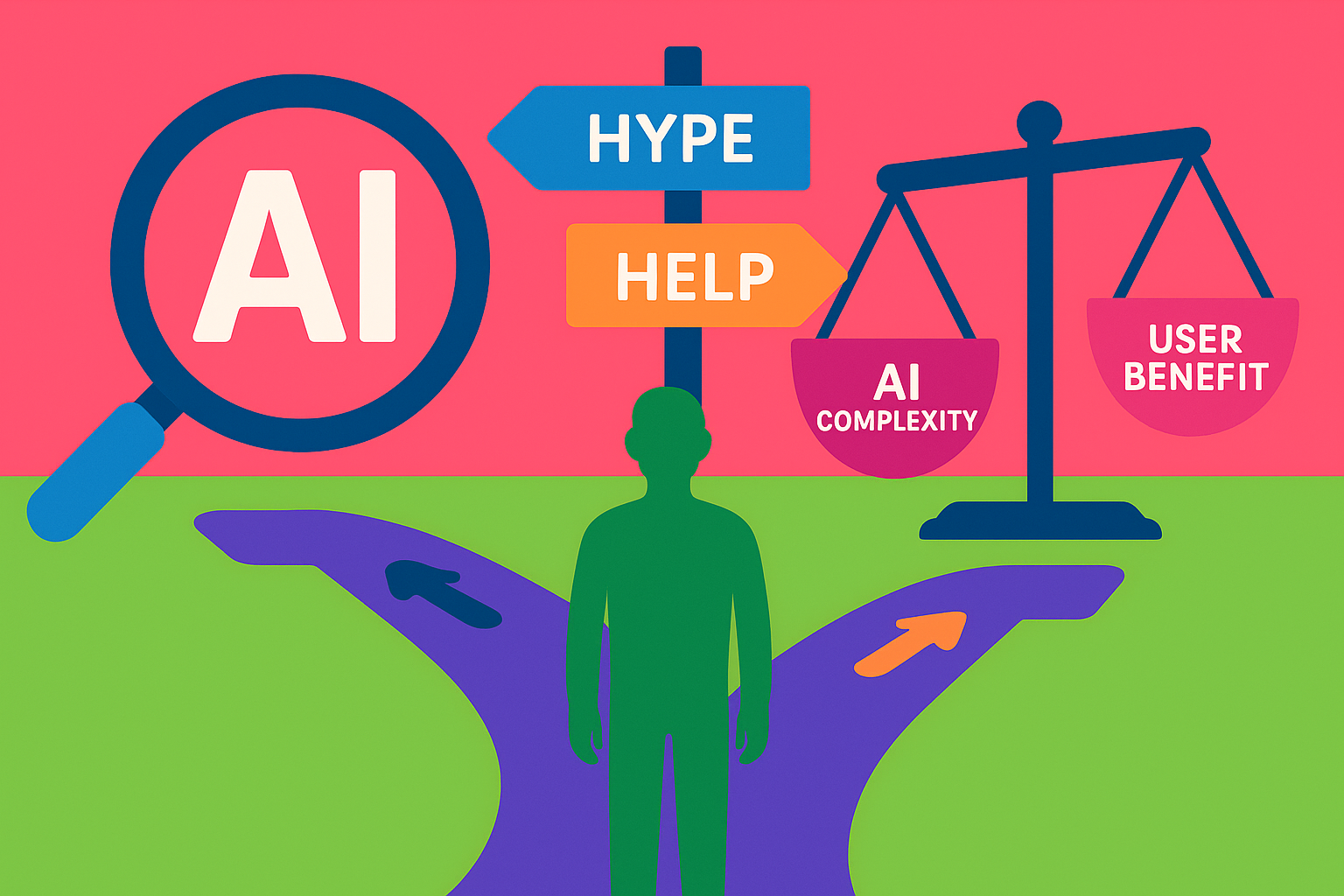
Here's my simple trick: Cover up the letters "AI" and ask yourself—does this feature still make sense?
After helping dozens of startups navigate their tech decisions, this one test cuts through the hype faster than anything else.
The Cover-Up Test for Features
When someone proposes an AI feature, mentally remove "AI" from the description and ask:
- Is there still a clear benefit to users?
- Does the feature still solve a real problem?
- Would customers still want this?
- Is there a simpler way to do the same thing?
If the answer is yes to the first three and no to the last one, you might have a feature worth building. If everything falls apart without that AI label, you're looking at a solution in search of a problem.
What Good AI Features Look Like
When you apply the cover-up test to solid AI features, here's what you find:
1. The Problem Exists Without AI
Good example: "Users waste 20 minutes sorting through their photos to find the ones they want to share."
That's a real problem. AI can solve it faster and better than manual tagging, but the problem exists either way. The feature makes sense because users are already struggling.
2. The Benefit is Concrete and Measurable
Strong features can explain their value in simple terms:
- "Saves users 15 minutes per day"
- "Reduces errors by 80%"
- "Answers customer questions instantly instead of making them wait 4 hours"
Notice none of those say "uses AI to..." The AI is just how you deliver the benefit, not the benefit itself.
3. AI Actually Makes It Better (Not Just Different)
AI should make things:
- Faster - Tasks that took 30 minutes now take 30 seconds
- More accurate - Fewer mistakes than the old way
- More personalized - Adapts to each user instead of one-size-fits-all
- Possible at scale - Can handle 10,000 users as easily as 10
If AI just makes something different but not measurably better, question whether you need it.
4. Users Don't Need to Know It's AI
The best AI features just work. Users think "wow, this app is smart" not "wow, this app uses AI." If you have to tell people it's AI for them to appreciate it, the feature probably isn't delivering enough value on its own.
Red Flags: When AI Features Don't Make Sense
Here are the warning signs that an AI feature is more hype than help:
The Feature Creates a Problem to Solve
Bad example: "Let's add an AI chatbot so users can ask questions!"
Wait—are users actually asking questions right now? Where? Do they struggle to find answers? Or are you creating a new interaction pattern just because you can?
If users aren't already trying to do something, adding AI to do it won't help.
The Old Way Works Fine
Be honest: Does the current solution actually have problems?
If your search function works well and users can find what they need, "AI-powered search" might be solving a problem you don't have. That's money and time you could spend on features users are asking for.
It's Added Solely Because Competitors Have It
"Everyone's adding AI features" isn't a strategy. Your competitor might be making the same mistake you're about to make. Or their users might have different needs than yours.
The Complexity Isn't Worth the Benefit
AI features are expensive to build and maintain:
- They need training data
- They require ongoing monitoring
- They can behave unpredictably
- They need careful testing
- They often need human review systems
If the benefit to users is small, that cost might not be justified. Sometimes a simple dropdown menu beats an AI assistant.
Users Have to Change Their Behavior
If your AI feature requires users to do something completely new, adoption will be hard. The best features fit into how people already work, just making it easier or faster.
Real-World Examples
Let's look at some actual AI feature decisions:
Makes Sense:"Our photo app uses AI to automatically tag faces, so users can search 'photos with Mom' instead of scrolling through thousands of images."
Remove AI: You still have a search feature that solves a real problem (finding specific photos is hard). AI just makes it work way better than manual tagging ever could.
Doesn't Make Sense:"We're adding an AI writing assistant to our project management tool."
Remove AI: Do users struggle with writing in your tool? Are they asking for help? Or are you adding a feature because it sounds cool? If users aren't already trying to write better in your app, this might miss the mark.
Makes Sense:"Our scheduling app uses AI to suggest meeting times based on everyone's calendars and past preferences."
Remove AI: You're solving the annoying problem of email chains with 12 people trying to find a time to meet. The AI just makes the solution work across complex scenarios.
Doesn't Make Sense:"Let's add AI-generated summaries to every email in our inbox."
Remove AI: Are summaries actually useful for short emails? Will users trust them? Do people struggle to read their emails, or do they struggle with too many emails (which summaries don't solve)?
Questions to Ask Before Building Any AI Feature
When evaluating an AI feature proposal, work through these questions:
1. What's the actual problem?
Write it down without using the word "AI." If you can't describe a clear problem, you don't need a solution yet.
2. How do users solve this today?
What's their current workaround? What do they hate about it? This tells you what to improve.
3. How will we measure success?
Pick real metrics: time saved, errors reduced, completion rate improved. "Uses AI" isn't a metric.
4. What's the simpler alternative?
Before jumping to AI, could you solve this with:
- Better UI/UX?
- A smarter filter or search?
- Automation without machine learning?
- Just showing users the right information?
Sometimes the simple solution is the right solution.
5. What happens when it gets it wrong?
AI makes mistakes. What's the user experience when it does? Is there an easy fix? Or will errors cause major problems?
6. Do we have the data to train it?
AI needs examples to learn from. Do you have enough quality data? If not, can you get it? How long will that take?
The Cost of AI Features
Here's what many founders don't realize: AI features are expensive beyond the initial build.
Development costs:
- Often 2-3x more expensive than traditional features
- Require specialized talent (which costs more)
- Take longer to build and test
- Need more QA time
Ongoing costs:
- API fees for AI services can scale up fast
- Monitoring and improvement never stops
- Technical debt accumulates if not maintained
- Training data needs updates
For a small startup with limited resources, one AI feature might eat up the budget for three traditional features. Is it worth it?
When AI Features Actually Make Sense
Don't get me wrong—AI can be incredible when used right. Build AI features when:
The problem is genuinely complex
Things like understanding natural language, recognizing images, predicting patterns—these are hard problems where AI excels.
Users are already struggling
You're not creating new behavior; you're making existing behavior easier.
The benefit is significant
It should save major time, money, or frustration. Small improvements don't justify the cost.
You have the resources
Both money and time to build it right. A half-baked AI feature is worse than no AI feature.
It fits your roadmap
Does this align with where your product is going? Or is it a distraction from more important work?
A Better Approach
Instead of asking "Should we add AI?", ask:
- What are our users' biggest frustrations? (Talk to them!)
- Which problems are we not solving well? (Look at support tickets)
- Where do users abandon our app? (Check your analytics)
- What features do they keep requesting? (Review feedback)
Then ask: "Would AI help solve any of these better than other approaches?"
This way, AI becomes a tool to solve real problems, not a feature looking for a purpose.
The Bottom Line
AI is powerful. But it's not magic, and it's not always the answer.
Before you commit budget, time, and engineering resources to an AI feature:
- Cover up the "AI" in the description
- See if it still makes sense
- Make sure you're solving a real problem
- Verify the benefit justifies the cost
The best products use AI where it matters and skip it where it doesn't. Your job isn't to have the most AI—it's to build something users love.
So the next time someone pitches you an AI feature, try the cover-up test. Your users (and your budget) will thank you.
Need help deciding which features are worth building? Whether it's AI or anything else, we can help you prioritize your roadmap and make smart technology decisions. Get in touch for guidance on your product strategy and development.