The 5 Signs You Need a Technical Advisor, Not Just a Dev Shop
Excerpt: Building software? A dev shop codes what you ask for. A technical advisor helps you figure out what to actually build.
So you've got a brilliant idea for an app or website. You know you need developers to build it, but here's the million-dollar question: Do you just need someone to write code, or do you need someone to help you think through the why and what before the coding even starts?
Most first-time founders think they just need a codebase built. They shop around for the cheapest development team and hand over their idea, expecting magic to happen. But here's the thing – great software isn't just about great code. It's about building the right thing in the right way.
A dev shop will build exactly what you tell them to build. A technical advisor will help you figure out if that's actually what you should be building in the first place.
Here are five clear signs you need a technical advisor on your team, not just developers with keyboards.
1. You Keep Getting Wildly Different Price Quotes
You've reached out to five different development companies for quotes on your "simple" app idea. One comes back with $15,000. Another says $150,000. The third asks for detailed requirements or a discovery phase before they'll even consider giving you a number.
What's happening: Each dev shop is making completely different assumptions about what you want built. Some are shooting from the hip with wild guesses. Others (the smart ones) recognize they can't give you an accurate quote without understanding what you actually need. The problem isn't that some require discovery – it's that you don't have clear enough requirements for anyone to quote accurately.
Why you need an advisor: A technical advisor helps you create crystal-clear requirements before you ever talk to developers. When every dev shop has the same detailed documentation, you can actually compare apples to apples. Plus, you'll avoid the nightmare of scope creep that turns your $30k project into a $100k disaster.
2. Developers Keep Asking You Technical Questions You Can't Answer
"Do you want this to be real-time or batch processed?"
"What's your expected load capacity?"
"Should we use REST or GraphQL for the API?"
You stare blankly. These sound like English words, but you have no idea what they mean or how to answer.
What's happening: Good developers ask these questions because the answers dramatically affect how they build your product. But if you can't answer them (and that's totally normal!), your project is flying blind.
Why you need an advisor: A technical advisor translates between your business needs and technical requirements. They know that when you say "I need users to see updates immediately," that affects database design, server costs, and development complexity. They make these technical decisions so developers can focus on building instead of guessing.
3. You Have No Idea What Questions to Ask
You know you want an app. You've seen apps you like. But when it comes to actually planning yours, you feel lost. Should it be native or web-based? How do you handle user accounts? What about payments? Security? Scaling?
The list of things you don't know feels endless, and Google searches just make it worse.
What's happening: Building software involves thousands of small decisions that compound into big consequences. Without technical knowledge, you can't even identify what questions need answering, let alone answer them.
Why you need an advisor: Technical advisors have built enough products to know every question that needs asking. They've seen what happens when you skip the "boring" stuff like automated testing or proper security measures. They help you avoid expensive mistakes by thinking through problems before they become problems.
4. You've Been Burned by "Too Good to Be True" Proposals
That overseas team promised to build your entire platform for $5,000 in six weeks. Six months later, you have a broken mess that can't handle real users, and they're asking for another $10,000 to "fix some small issues."
Or maybe you hired your nephew's friend who "knows coding" and is willing to work for equity. A year later, you have nothing usable and a very awkward family dinner situation.
What's happening: Cheap proposals usually mean someone either doesn't understand what you're building or is planning to cut corners you didn't know existed. You're getting what you pay for – or less.
Why you need an advisor: A technical advisor helps you spot red flags in proposals and team capabilities. They know what realistic timelines and budgets look like. More importantly, they help you define your project properly so you can evaluate whether a team can actually deliver what you need.
5. You Want to Make Smart Technical Decisions for the Future
You're not just building an app for today – you're building a business for tomorrow. You want to make sure your technical choices support your growth, not limit it. But every blog post about "tech stacks" and "frameworks" makes your head spin.
What's happening: Technology decisions you make today will affect your business for years. Choose the wrong database? You might hit scaling limits sooner than expected. Pick an outdated framework? You'll struggle to find developers for maintenance. Make security an afterthought? Hello, expensive compliance requirements later.
Why you need an advisor: Technical advisors think beyond just "making it work." They consider your business goals, growth plans, budget constraints, and long-term maintenance needs. They help you build a foundation that grows with your business instead of holding it back.
The Bottom Line
A dev shop is like a construction crew – they're amazing at building what's on the blueprints. But if your blueprints are incomplete, unclear, or just plain wrong, you'll end up with a beautiful building in the wrong location with no plumbing.
A technical advisor is like your architect. They help you figure out what you actually need to build, where to build it, and how to build it right. They make sure your blueprints are solid before the first line of code gets written.
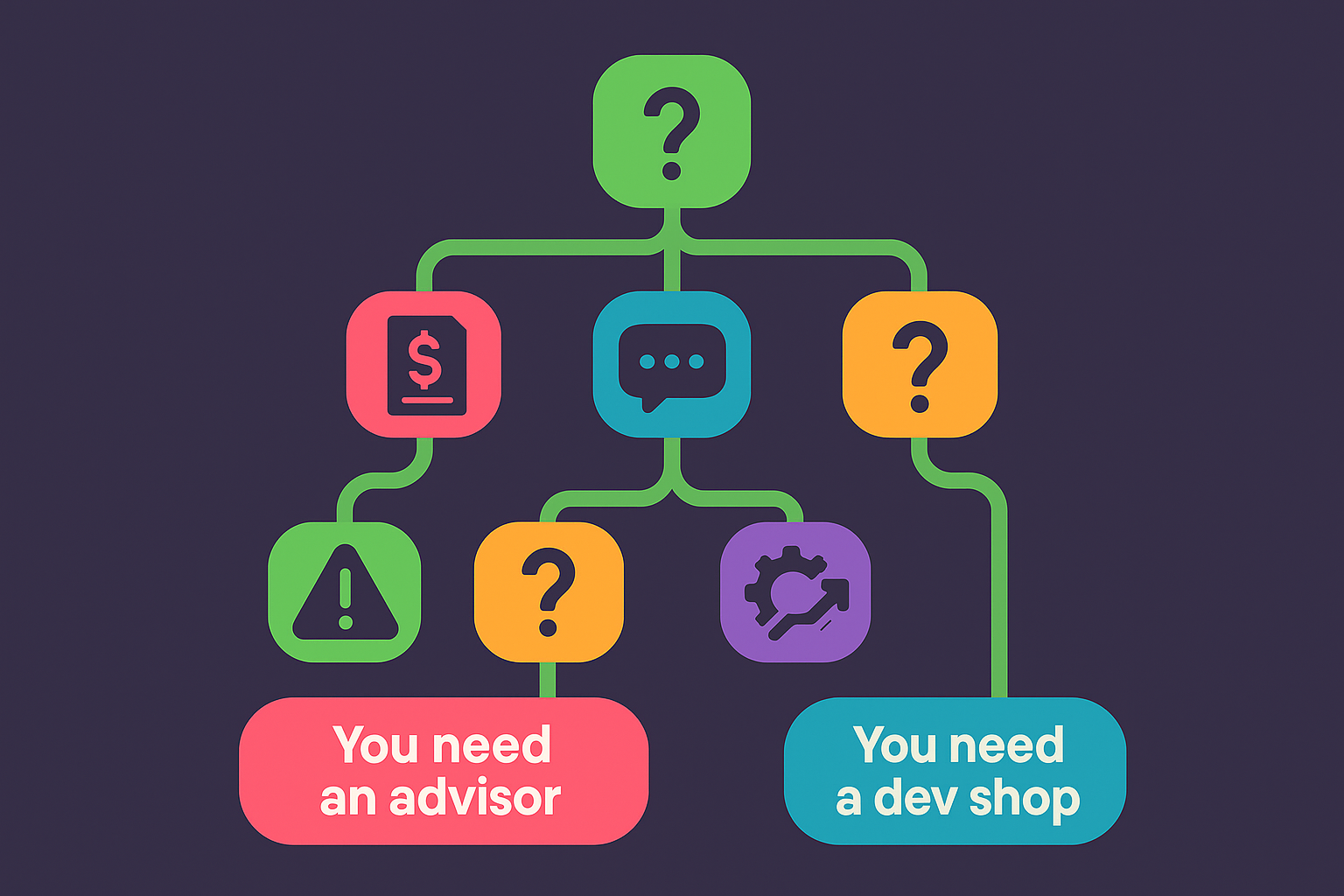
Here's how to tell which one you need:
- Just need a dev shop: You have detailed technical requirements, clear wireframes, and a solid understanding of what success looks like.
- Need a technical advisor: You have a business idea and goals, but need help translating those into technical requirements and strategy.
Most first-time founders need both – an advisor to help with strategy and planning, then a development team to execute the plan. The good news? You don't need to juggle multiple vendors. The best approach is finding a partner who can guide your technical strategy and build your product, ensuring seamless handoff from planning to execution.
Trying to skip the advisory phase and go straight to development is like trying to build a house without an architect. It might work out, but it probably won't.
Ready to get your technical strategy sorted before you start building? Get in touch with us for expert guidance on turning your vision into a rock-solid development plan – and the team to bring it to life.