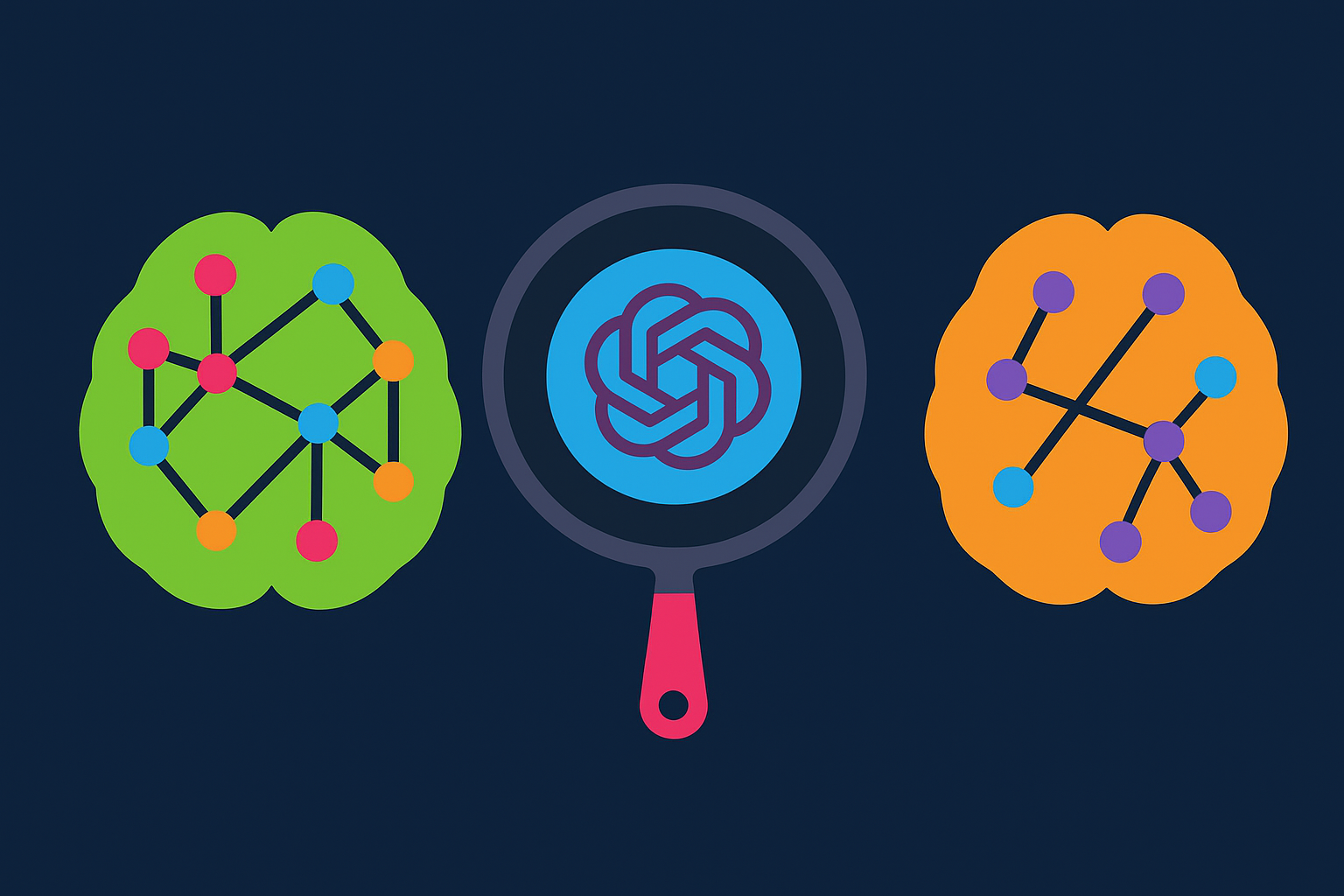
Remember those "This is your brain on drugs" commercials from the 90s? An egg. A frying pan. A sizzle. "Any questions?"
Well, scientists just cracked open what your brain looks like on ChatGPT. And honestly? The comparison isn't as far-fetched as you'd think.
Turns out, when you rely heavily on AI to do your thinking, your brain doesn't exactly fry like that egg—but it does something arguably worse: it goes dormant. Neural connections weaken. Memory encoding fails. The mental muscles you need for complex problem-solving just... stop developing.
And if you're building a career in engineering? That's not a quirky side effect. That's a career-ending problem.
A groundbreaking new study from MIT just gave us the neuroscience receipts. And when you combine those findings with what's happening in the engineering job market right now? The picture gets real interesting, real fast.
The Great Brain Experiment
Researchers at MIT did something pretty clever. They gathered 54 college students and split them into three groups:
Group 1: Could only use ChatGPT to write essays
Group 2: Could use Google and websites (but no AI)
Group 3: Had to rely on their brain alone (no tools at all)
Each person wrote essays across multiple sessions while wearing EEG headsets that measured their brain activity. Think of it like putting your brain under a microscope while you work.
Here's where it gets interesting.
The Results That'll Make You Think Twice
Your Memory Takes a Hit
Remember that essay you "wrote" with ChatGPT last week? Quick, quote a sentence from it without looking.
Can't do it? You're not alone.
A whopping 83% of people using ChatGPT couldn't quote a single line from their own essays minutes after finishing them. Compare that to people using Google (only 11% struggled) or those working solo (also 11%).
Your brain literally isn't encoding the information when AI does the work for you.
Now imagine that's not an essay. Imagine that's your codebase. You wrote it (technically), but do you actually understand it?
Your Brain Goes Into Power-Saving Mode
The EEG data revealed something fascinating. When people used ChatGPT, their brain connectivity patterns looked dramatically different. Their neural networks basically took a nap.
The Brain-only group? Their brains lit up like Times Square on New Year's Eve. Wide-ranging neural networks firing across multiple regions. Deep thinking. Real cognitive engagement.
The ChatGPT group? Minimal brain activity. It's like their brains said, "Eh, AI's got this. I'm gonna chill."
This isn't your brain on drugs. This is your brain on AI. And for engineers learning to solve problems? The long-term effects might be just as serious.
You Don't Actually Own What You Create
When asked how much of their essay they "owned," the answers were telling.
Brain-only folks: Nearly everyone claimed 100% ownership
Google users: Most said 90-100% ownership
ChatGPT users: All over the map. Some said 100%, others admitted it felt 50-50, and a few said they felt zero ownership
One participant flat-out said using ChatGPT "feels like cheating."
The Real-World Impact: What's Happening in Engineering Right Now
Here's where the MIT study stops being just interesting research and starts becoming a career wake-up call.
The Junior Engineer Crisis
According to a September 2025 IEEE Spectrum analysis, employment for young workers in AI-exposed jobs, including early-career software engineers, has fallen 6 percent since late 2022. This isn't just a hiring slowdown—it's a fundamental shift in how the industry values experience.
And here's the kicker: research from Stanford's AI Index Report found that companies adopting GitHub Copilot are hiring software engineers who need fewer advanced programming skills. Sounds great for accessibility, right?
But pair this with the MIT findings, and you've got a problem.
Junior engineers using AI tools heavily aren't building the mental models they need to become senior engineers.
Think about what the study showed: People using LLMs couldn't remember what they'd written. Their brains showed weaker connectivity. They felt less ownership over their work.
Now apply that to your first two years as an engineer. If you're relying on Copilot or ChatGPT to write most of your code, you're not developing the deep understanding of:
- How systems actually work under the hood
- Why certain patterns exist and when to break them
- How to debug complex problems without AI assistance
- The architectural thinking that separates good engineers from great ones
The Twist: Some People Actually Get Better
But here's where the study got really interesting. In the fourth session, researchers switched things up. People who'd been using ChatGPT had to write without it. People who'd been flying solo got to use ChatGPT for the first time.
The ChatGPT Withdrawal Effect
When regular ChatGPT users tried writing alone, their brains struggled. Even though they scored well on the essays, their neural connectivity was weaker than people who'd been practicing brain-only writing all along.
It's like they'd gotten so used to the AI crutch that their mental muscles had atrophied. Sound familiar? It's the same principle behind any dependency—take away the thing you've been relying on, and suddenly you realize your own capabilities have diminished.
The Fresh AI Users Surprise
Meanwhile, people who'd been writing on their own suddenly got access to ChatGPT. Their brains actually showed MORE activity than the longtime ChatGPT users. They were actively engaging with the AI, questioning it, integrating its suggestions with their own knowledge.
They treated it like a tool, not a replacement.
This is the difference between senior engineers and junior ones right now. Senior engineers learned to code before AI. They built their mental models the hard way. Now they use AI as a productivity multiplier. They can spot when ChatGPT is hallucinating or suggesting bad patterns because they have the experience to know better.
But if your entire learning journey involves an AI assistant? You're building a house on sand.
The Market is Splitting Engineers in Two
Indeed's 2025 AI at Work Report found that almost half (46%) of skills in a typical US job posting are poised for "hybrid transformation" by GenAI, where human oversight remains critical but GenAI can perform a significant portion of routine work.
The MIT study showed us exactly what this split looks like at the brain level. And it's creating two very different career paths:
Path 1: The AI-Dependent Engineer (The ChatGPT Group)
- Relies heavily on AI tools for basic tasks
- Weak neural connectivity and memory encoding
- Struggles with complex problems requiring deep understanding
- Has weak fundamentals but can move fast on simple projects
- Gets stuck when AI can't solve the problem
- Low ownership over their work
- Faces job insecurity as AI improves
Path 2: The AI-Enhanced Engineer (The Brain-First Group)
- Strong foundational brain connectivity and problem-solving
- Uses AI strategically as a productivity tool
- Can work with or without AI assistance
- Knows when to trust AI and when to override it
- High ownership and understanding of their work
- Becomes more valuable as AI adoption increases
The neuroscience backs this up. Session 4 of the study proved it: your brain adapts to how you work. Use AI as a crutch from day one, and your brain never builds the connections it needs. Build strong fundamentals first, then add AI, and you get the best of both worlds.
The Numbers Don't Lie
A World Economic Forum report from October 2025 revealed that today, 94% of leaders face shortages in AI-critical roles, with around one-third reporting gaps of 40-60%. But here's the twist: by 2028, half of leaders report expecting 10-20% overcapacity primarily due to automation.
Translation: There will be tons of jobs for engineers who can work with AI effectively—the AI-Enhanced Engineers whose brains show strong connectivity and deep understanding.
But if AI can do your job without you adding value beyond prompting it? That role is disappearing. Your weakened neural networks won't save you.
According to Rutgers Engineering research, many organizations are finding it challenging to fill AI-related roles, pointing to strong demand for skilled experts—but those are roles requiring the kind of deep cognitive engagement the MIT study measured in the Brain-only and Search Engine groups, not the passive reliance seen in long-term ChatGPT users.
The Skills That Protect Your Career (And Your Brain)
The World Economic Forum noted in January 2025 that in roles that were once less likely to value human skills, the importance of these skills has grown by 20% since 2018. The MIT study showed us why: these are the skills that require the kind of brain connectivity AI can't replicate.
Technical Fundamentals (Build Strong Neural Pathways First)
- Deep understanding of data structures and algorithms
- System design and architecture
- Performance optimization
- Security principles
- Problem-solving without AI assistance
AI Literacy (But Used Strategically)
- Prompt engineering and proficiency with tools like ChatGPT or Copilot
- Understanding AI limitations and failure modes
- Knowing when to use AI vs. when to code manually
- Validating and testing AI-generated code
- Maintaining ownership and understanding of AI-assisted work
Human Skills (What Strong Brain Connectivity Enables)
- As Amtec's April 2025 analysis highlighted, modern engineering education is emphasizing communication, ethical reasoning, and collaboration
- Systems thinking and architectural vision
- Teaching and mentoring (the study showed you need to understand something deeply to explain it)
- Critical thinking and judgment
- Memory and recall (what the ChatGPT group lost)
What This Actually Means for Your Career
Remember: AI Critique's 2025 analysis found that wholesale unemployment of engineers is not occurring; instead, we see a dynamic shift where roles are redefined and skills requirements are climbing.
The MIT study showed us what's happening at the neurological level behind this shift.
If you're early in your career:
Don't use AI as a crutch. Use it as training wheels you remove as soon as possible. The study proved that early, heavy AI use weakens the brain connectivity you need for complex problem-solving. Build your fundamentals first—let your brain develop those strong neural pathways—then add AI tools to amplify what you already know.
Your brain is literally adapting to how you work right now. Make sure it's adapting in the right direction.
If you're hiring engineers:
The study gives you a new interview framework. Look for people who can explain their thinking, not just their output. Ask them to debug code without AI assistance. See if they can quote their own work. Check if they feel ownership over what they've built.
The ChatGPT group couldn't do any of these things well. The Brain-only and Search Engine groups could. That difference matters.
If you're building products:
Your competitive advantage isn't having AI tools (everyone has those). It's having engineers with the kind of strong brain connectivity the study measured in successful participants—people who understand systems deeply enough to use AI effectively while avoiding its pitfalls.
Modern engineering education is shifting toward cross-domain fluency, emphasizing ethical reasoning, communication, and collaborative skill development alongside technical expertise. But the MIT study shows us that none of this matters if your brain isn't building the underlying neural connections that support real learning.
The Bottom Line: Your Brain and Your Career
So here we are. This is your brain on AI.
Not fried like an egg, but dimmed. Neural pathways weakened. Memory impaired. Critical thinking diminished.
The MIT study showed that using LLMs weakens memory, reduces brain connectivity, and impairs ownership of work. The engineering job market is showing that AI-dependent workers struggle while AI-enhanced workers thrive.
These aren't two separate stories. They're the same story told from different angles.
An engineer who can't remember their codebase, doesn't deeply understand their system architecture, and doesn't feel ownership over their work isn't building a sustainable career. The neuroscience proves it. The job market confirms it.
PwC's 2025 Global AI Jobs Barometer found that skill change in AI-exposed jobs is accelerating—up 25% faster than last year. If you've built your career on weak neural foundations by letting AI do your thinking from day one, you don't have the cognitive flexibility to adapt.
But here's the good news: Using AI isn't the problem. How you use it is.
The study found Session 4 participants who learned without AI first and then adopted it showed stronger brain activity and better integration than long-term AI users. It's not too late to build those foundations. It's not too late to train your brain properly.
The future isn't about humans versus AI. It's about engineers whose brains developed strong connectivity through real problem-solving versus those who never built that capacity.
The choice you make now about how you use AI tools will determine which side of that divide you're on five years from now—both neurologically and professionally.
Your brain is adapting. The market is shifting. Make sure they're both moving in the right direction.
Any questions?
Building a team or product in this AI-first era? We help companies navigate the balance between AI efficiency and human expertise—making sure your engineering teams develop the cognitive foundations and strategic thinking that actually matter. Let's talk about your technical strategy and build something that sets your team up for long-term success.
Sources and Further Reading
Primary Research:
- Kosmyna, N., Hauptmann, E., Yuan, Y. T., Situ, J., Liao, X., Beresnitzky, A. V., Braunstein, I., & Maes, P. (2025). "Your Brain on ChatGPT: Accumulation of Cognitive Debt when Using an AI Assistant for Essay Writing Task." MIT Media Lab. Read the full study
Industry Analysis and Job Market Data: